


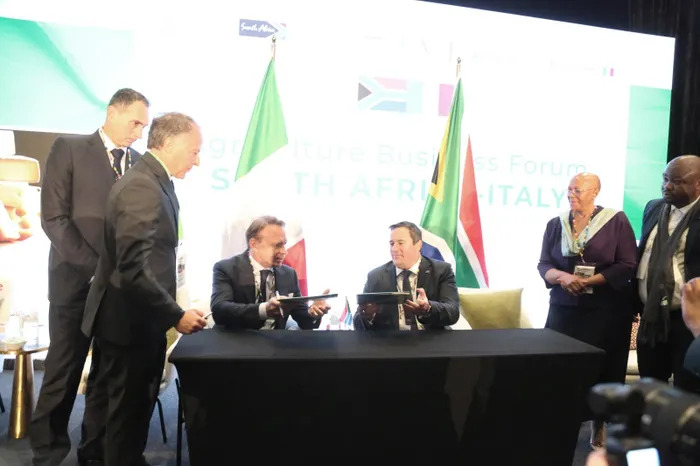
South Africa and Italy have signed a new memorandum of understanding aimed at expanding agricultural cooperation, strengthening trade relations and accelerating innovation across key segments of the agrifood sector, as both countries seek to build more resilient and competitive food systems.The agreement was concluded on the sidelines of the inaugural South Africa–Italy Agrifood Forum, held on June 9 and 10, and establishes a framework for collaboration in areas ranging from agricultural research and innovation to biosecurity, animal health, plant health and skills development.
According to South Africa’s Department of Agriculture, the memorandum is designed to deepen long-term cooperation between the two countries while creating new opportunities for investment, technology transfer and knowledge exchange. The partnership is also expected to support agricultural trade and strengthen the capacity of both nations to address emerging challenges facing global food systems.
The agreement comes at a time when governments around the world are increasingly prioritising agricultural resilience in response to climate change, disease outbreaks, supply chain disruptions and growing food demand. For South Africa, the partnership aligns with broader efforts to modernise agricultural value chains, expand agro-processing capacity and increase the sector’s contribution to economic growth and employment.
South African Minister of Agriculture John Steenhuisen said the collaboration reflects a shared commitment to building a more productive and sustainable agricultural future.
“We want to produce more food with fewer resources. We want stronger rural economies and more jobs. We want resilient food systems that can withstand climate shocks, disease outbreaks and market disruptions,”Steenhuisen said during the forum.
“We also want to ensure that the next generation sees agriculture not as an industry of the past, but as one of the most promising sectors of the future,” he added.
The memorandum covers several strategic areas that are becoming increasingly important to agricultural competitiveness. These include cooperation on biosecurity measures, livestock production, animal and plant health systems, agricultural research programmes, innovation initiatives and workforce development. Experts note that stronger biosecurity systems are particularly important as international trade expands and agricultural producers face rising risks from transboundary pests and diseases. Improved collaboration in this area could help both countries protect agricultural productivity while maintaining access to export markets.

The agreement also places significant emphasis on research and innovation, reflecting growing recognition that technological advancement will play a central role in addressing food security challenges and improving agricultural sustainability. Knowledge exchange between research institutions, universities and private-sector actors is expected to form a key component of the partnership.
South Africa enters the collaboration with one of the most advanced and diversified agricultural sectors on the African continent. The country produces a wide range of commodities, supported by diverse climatic conditions that enable farming systems ranging from livestock production in arid regions to horticulture, grain cultivation and high-value export agriculture.
According to the International Trade Administration, South Africa’s varied geography provides a unique agricultural advantage, supporting production systems that span Mediterranean, subtropical and semi-arid climatic zones. This diversity has helped the country establish itself as a major agricultural exporter and an important supplier to regional and global markets.
The country’s membership in the African Continental Free Trade Area (AfCFTA) further enhances its strategic position, offering access to a rapidly expanding consumer market and creating opportunities for agricultural exports and value-added products.

https://www.aecweek-registration.com/2026/
The new partnership with Italy could support South Africa’s ambitions to capture greater value from agricultural production through expanded processing and manufacturing activities. President Cyril Ramaphosa has identified value addition as a priority area for economic development and has set a target of increasing value creation within the agricultural sector by 30%.
Achieving that goal will require investment in infrastructure, technology and agro-industrial capabilities, areas where Italy has established considerable expertise. The European country is internationally recognised for its advanced food processing industries, agricultural technology innovation and strong agro-industrial value chains.
Industry analysts suggest that closer collaboration with Italian businesses and institutions could help South Africa strengthen domestic processing capacity, create new employment opportunities and improve the competitiveness of locally produced agricultural products in international markets.
The agreement builds on an already established relationship between the two countries that includes technical cooperation, technology transfer initiatives and market-access programmes. Agricultural collaboration has gradually expanded in recent years as both governments seek to unlock new opportunities for trade and investment.
According to South African government data, agricultural trade between South Africa and Italy currently exceeds 650 million rand, equivalent to approximately $39.4 million annually. Officials believe there is substantial room for further growth, particularly in high-value agricultural products, processed foods and agribusiness investments.In a further sign of deepening agricultural ties, the two countries also signed a technical agreement allowing Italian table grapes to access the South African market. The move is expected to enhance bilateral trade flows while providing consumers with greater product diversity.
The agreements reflect a broader trend of international partnerships focused on strengthening food systems through innovation, sustainability and trade cooperation. As countries confront the challenges of climate change, population growth and evolving consumer demands, cross-border collaboration is increasingly viewed as essential to ensuring long-term agricultural resilience and economic competitiveness.
For South Africa, the partnership with Italy represents another step toward building a more dynamic and value-driven agricultural sector capable of creating jobs, supporting rural development and expanding the country’s role in regional and global agrifood markets. By combining South Africa’s agricultural potential with Italy’s agro-industrial expertise, both countries aim to unlock new opportunities for growth while contributing to more sustainable and resilient food systems.


