


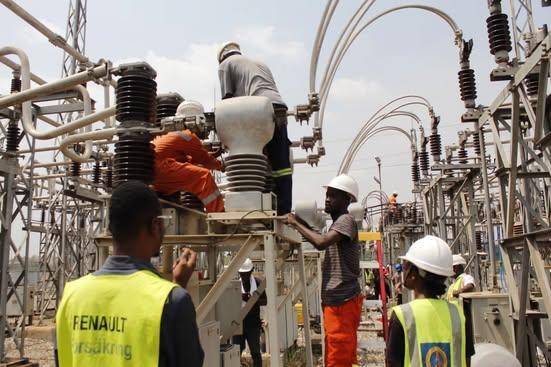
Ghana’s Ministry of Energy and Green Transition has received the findings of an official investigation into the fire that damaged the Akosombo Substation, a key component of the country’s electricity transmission network, with investigators concluding that ageing infrastructure rather than sabotage was responsible for the incident. The inquiry, commissioned by the ministry in 2026 and overseen by Energy Minister Dr John Abdulai Jinapor, examined the cause of the fire, assessed the extent of damage, and proposed measures aimed at strengthening the reliability and resilience of Ghana’s power system.
According to the report submitted by a seven-member investigative committee, the fire originated within the low-voltage panel section of the substation after insulation deterioration in ageing electrical cables triggered abnormal current flow. Engineers determined that the resulting overheating led to ignition and subsequent damage to critical equipment. The findings ruled out deliberate interference or sabotage, instead identifying long-term technical degradation as the primary factor behind the incident.
 Committee Chair Engineer William Amuna stated that deteriorating insulation compromised the integrity of the electrical system and created conditions that allowed the fault to escalate. According to the committee, the design and configuration of protective systems also contributed to the severity of the damage, as a secondary transformer continued supplying power to the faulted section, intensifying the fire and extending its impact on operational infrastructure.
The incident disrupted sections of Ghana’s electricity transmission system and renewed attention on the condition of strategic energy assets that support economic activity, industrial production, public services and household electricity supply. While power systems across Africa have expanded significantly over recent decades, many countries continue to face challenges associated with ageing infrastructure, deferred maintenance and growing electricity demand that places increasing pressure on existing networks.
Energy Minister Dr John Abdulai Jinapor welcomed the committee’s findings and confirmed that the government would review and act upon the recommendations. He also indicated that accountability measures would be pursued where negligence or failures in operational oversight are identified. The response reflects growing recognition across the continent that infrastructure governance is becoming as important as infrastructure expansion in maintaining energy security.
The committee recommended a combination of immediate corrective actions and longer-term structural reforms. These include urgent measures to restore operational stability at the substation, enhanced maintenance procedures, improved protection coordination systems, and the development of a modern control facility capable of supporting more advanced monitoring and grid management functions. According to energy sector analysts, such investments are increasingly necessary as power networks become more complex and interconnected.
The findings arrive at a time when many African countries are pursuing ambitious energy transition strategies that require reliable transmission and distribution infrastructure to support renewable energy integration, industrialisation and universal electricity access. While significant attention is often directed towards new generation capacity, transmission networks remain a critical but sometimes underfunded component of energy sector development. Failures within substations, transformers and distribution systems can undermine the benefits of broader investments in power generation.
For Ghana, the Akosombo Substation fire underscores the economic implications of infrastructure reliability. Electricity disruptions can affect manufacturing output, commercial activity, digital services and public institutions, while increasing operational costs for businesses that rely on backup generation. In economies seeking to attract investment and expand industrial capacity, the resilience of energy infrastructure is increasingly viewed as a determinant of competitiveness and economic stability.
The incident also highlights the growing role of predictive maintenance and digital monitoring technologies within modern energy systems. Utilities globally are investing in condition-based maintenance, smart sensors and real-time monitoring tools that can identify equipment deterioration before failures occur. Such approaches are gaining relevance across Africa as utilities seek to improve efficiency while managing constrained investment budgets.
From a sustainability perspective, infrastructure resilience forms a critical component of long-term energy security. Reliable electricity systems support economic development, healthcare delivery, education, digital connectivity and climate adaptation efforts. The ability to maintain continuous energy supply is increasingly recognised as a prerequisite for sustainable development rather than simply an operational objective.
 The recommendations emerging from the Akosombo investigation also align with broader continental priorities under the African Union’s Agenda 2063, which emphasises modern infrastructure, resilient institutions and sustainable economic transformation. As African countries continue to expand access to electricity while pursuing cleaner energy pathways, strengthening the reliability and governance of transmission networks is likely to become an increasingly important policy priority.
The Akosombo Substation fire may ultimately be remembered less as an isolated technical failure and more as a reminder of the strategic importance of maintaining and modernising critical infrastructure. For Ghana and other African economies facing similar challenges, the lessons from the investigation reinforce the need to balance new investment with the preservation and upgrading of existing assets that underpin economic growth and social development.


