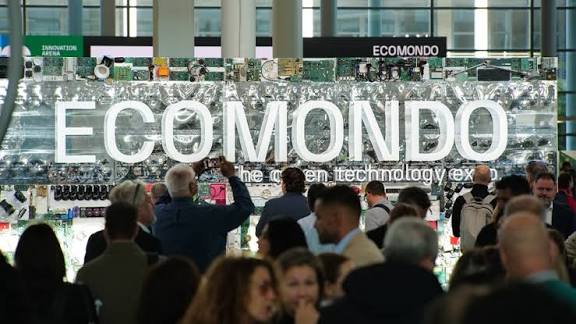
Italy’s circular economy ambitions are taking centre stage at Ecomondo 2026, which opened on 3 November in Rimini with government leaders and industry representatives calling for stronger links between environmental sustainability, industrial competitiveness and strategic resource security. The 29th edition of the international exhibition, organised by Italian Exhibition Group (IEG), brings together more than 1,800 exhibiting brands, international buyers, policymakers and research institutions to examine technologies and investment opportunities shaping the green, blue and circular economies.
The event, running until 6 November at the Rimini Expo Centre, was inaugurated by Gilberto Pichetto Fratin, Italy’s Minister for the Environment and Energy Security, alongside a video address from Adolfo Urso, Minister for Enterprise and Made in Italy. Their remarks placed resource efficiency and circular production systems within a wider industrial and geopolitical debate, as countries seek to reduce exposure to imported raw materials, strengthen supply chains and maintain competitiveness during the transition to lower-impact production.
Speaking at the opening ceremony, Pichetto Fratin described Ecomondo as a platform where the ecological transition is translated into practical solutions. He argued that sustainability should not be treated solely as an environmental obligation, but as an opportunity to improve production efficiency, reduce waste and generate economic value while limiting pressure on ecosystems.

The minister’s position reflects a growing policy emphasis on the relationship between industrial development and environmental performance. As demand for critical raw materials, energy and low-carbon technologies increases, the ability to recover and reuse resources is becoming an important consideration for manufacturers and governments. Circular production models can reduce the need for virgin materials, improve resource productivity and create new markets for recycling, repair, remanufacturing and industrial recovery.
Urso reinforced this argument in his video message, describing sustainability as an issue extending beyond environmental protection into industrial policy and geopolitics. He said Italy had established a strong position in the circular economy but continued to face the challenge of reducing dependence on foreign sources for materials. The government, he said, had made circularity part of its industrial policy, including in relation to critical raw materials.
His remarks highlight the strategic importance of material security for European industry. Manufacturing sectors that depend on imported minerals and processed materials remain exposed to international price fluctuations, supply disruptions and geopolitical tensions. Improving the recovery of materials from industrial waste and end-of-life products could help diversify supply sources and strengthen the resilience of domestic production systems. However, achieving this will require investment in recycling capacity, technology, collection systems and markets capable of absorbing recovered materials at scale.
For Italy, the challenge is to translate its circular economy performance into a broader industrial advantage. The country has developed significant capabilities in resource efficiency and waste recovery, but high dependence on imported materials remains a structural concern. The policy direction outlined at Ecomondo suggests that circularity is increasingly being viewed not only as an environmental objective but also as a means of strengthening industrial sovereignty and contributing to European strategic autonomy.
Maurizio Ermeti, President of Italian Exhibition Group, said the green economy was becoming increasingly important to the growth and competitiveness of Italy’s industrial system. He described Ecomondo as a platform connecting businesses, institutions, research organisations, policymakers and other stakeholders involved in the circular and regenerative economy. According to Ermeti, the event has expanded its role from a European exhibition into an increasingly international meeting point for markets and industry.
The opening ceremony also brought together Jamil Sadegholvaad, Mayor of Rimini; Fabrizio Lobasso, Deputy Director-General for Growth and Export Promotion and Central Director for the Sistema Italia and Investments at the Ministry of Foreign Affairs and International Cooperation; Maurizio Forte, Central Director for Export Sectors at the Italian Trade Agency; and Michele de Pascale, President of the Emilia-Romagna Region. Their participation reflected the role of national and regional institutions in promoting industrial innovation, international trade and investment in environmental technologies.
The international scale of this year’s exhibition is reflected in its size and participation. Ecomondo 2026 occupies 30 exhibition halls across 170,000 square metres and features more than 1,800 exhibiting brands, with international exhibitors increasing by 19%. Through collaboration with the Ministry of Foreign Affairs and International Cooperation and the Italian Trade Agency, the event is hosting more than 1,000 buyers from Europe, the Middle East, India, Pakistan, China, South-East Asia, North Africa, Sub-Saharan Africa, North America and Latin America.
More than 60 representatives from international associations and numerous associated members are also expected, with participation from countries including Egypt, Morocco, Greece, Serbia, Hungary, Spain and South Africa. Fourteen international trade delegations representing more than 100 companies are attending from Austria, Belgium, Canada, Chile, China, Denmark, Germany, Norway, the Czech Republic, Slovakia, Spain and Switzerland. Mexico has been designated the exhibition’s first guest country, while a new area dedicated to business and networking with African associations has been introduced.
The African component is particularly relevant as governments and businesses across the continent confront the need to expand industrial capacity while managing growing resource, waste and climate pressures. Opportunities in recycling, waste treatment, renewable energy, water management and resource recovery are increasingly connected to questions of infrastructure, finance and technology transfer. A dedicated networking space for African associations could provide an avenue for building commercial relationships and connecting African stakeholders with international suppliers and investors. The exhibition announcement, however, does not specify the participating African organisations or the scale of business commitments expected from the new area.
Alongside the exhibition, the 15th edition of the States General of the Green Economy has also begun. Organised by the Foundation for Sustainable Development in collaboration with the Ministry for the Environment and Energy Security, and under the patronage of the European Commission and the Ministry for Enterprise and Made in Italy, the forum provides a policy platform for assessing the direction of the green economy.
Its opening plenary included the presentation of the 2026 Report on the State of the Green Economy, which examines Italy’s progress and challenges across areas including climate action, energy, circularity, water, mobility and agriculture. The report’s findings offer a broader context for the discussions at Ecomondo, particularly as Italy seeks to reconcile industrial competitiveness with the need to accelerate its environmental transition.
The international plenary scheduled for 4 November, titled “Green Economy Perspectives in an Unpredictable Global Scenario”, will be organised in collaboration with Italy for Climate. It is expected to examine the main global dynamics influencing the ecological transition, including the changing economic and geopolitical conditions shaping investment and environmental policy.
The programme also places considerable attention on the financing, regulatory and operational conditions needed to scale circular economy solutions. A session on climate transition plans for ESG risk management will examine the roles of companies and investors in managing transition-related risks. Organised with the Sustainable Investment Forum, the discussion reflects the increasing relevance of credible transition planning to capital allocation, corporate strategy and financial risk assessment.
Other sessions will address the relationship between circularity and defence industries, the paper and grocery supply chain, and the application of circular economy principles in the built environment. Discussions on urban mining, organised with the Green Building Council Italy and the Polytechnic University of the Marche, will examine how materials embedded in buildings and infrastructure can be recovered and reused. A separate session on Smart Circular Cities, organised with the University of Bologna, will explore approaches to applying circular economy principles within urban systems.
Regulatory developments will also feature prominently, particularly through discussions on the Circular Economy Act and the challenges of closing the loop in waste management. Organised with Utilitalia, the session will consider the changing regulatory landscape and its implications for waste management operators and the wider industrial sector. These discussions are important because the expansion of circular business models depends not only on technological innovation but also on predictable regulation, effective enforcement and functioning markets for secondary materials.
The event’s programme further includes the fifth edition of the Forum on Responsible Communication, organised by Ecomondo’s Technical Scientific Committee and the Italian Federation of Public Relations (FERPI). Under the theme “Communication on a Razor’s Edge: The Sustainable Transition Between Environmental Urgency and Social Cohesion”, the forum will examine how sustainability is communicated amid competing public priorities and the need to maintain social support for environmental policies.

The range of discussions reflects the increasingly interconnected nature of the green economy. Circularity is no longer confined to waste management or recycling targets. It has implications for industrial procurement, infrastructure design, investment decisions, corporate reporting, urban planning and international trade. The ability to recover materials and reduce resource consumption can influence both production costs and exposure to external supply risks.
For African economies, Ecomondo’s expanding international participation and its new networking area for African associations offer an opportunity to engage with these developments. Many African countries are seeking to strengthen domestic manufacturing, improve waste management systems and develop markets for recovered materials, while also addressing the infrastructure and financing constraints that limit the expansion of circular industries. Engagement with international technology providers and investors could support knowledge exchange and commercial partnerships, although the benefits will depend on whether such relationships translate into locally relevant investment, skills development and industrial capacity.
As Ecomondo 2026 continues in Rimini, the central policy message from its opening ceremony is that environmental transition and industrial competitiveness are increasingly being treated as connected priorities. Italy’s ambition to turn its circular economy capabilities into a source of strategic advantage will depend on its ability to reduce imported material dependence, scale innovation and strengthen domestic recovery systems. The wider international test will be whether the technologies, partnerships and policy discussions showcased at the exhibition can move beyond demonstration and generate measurable changes in how economies produce, consume and manage resources.