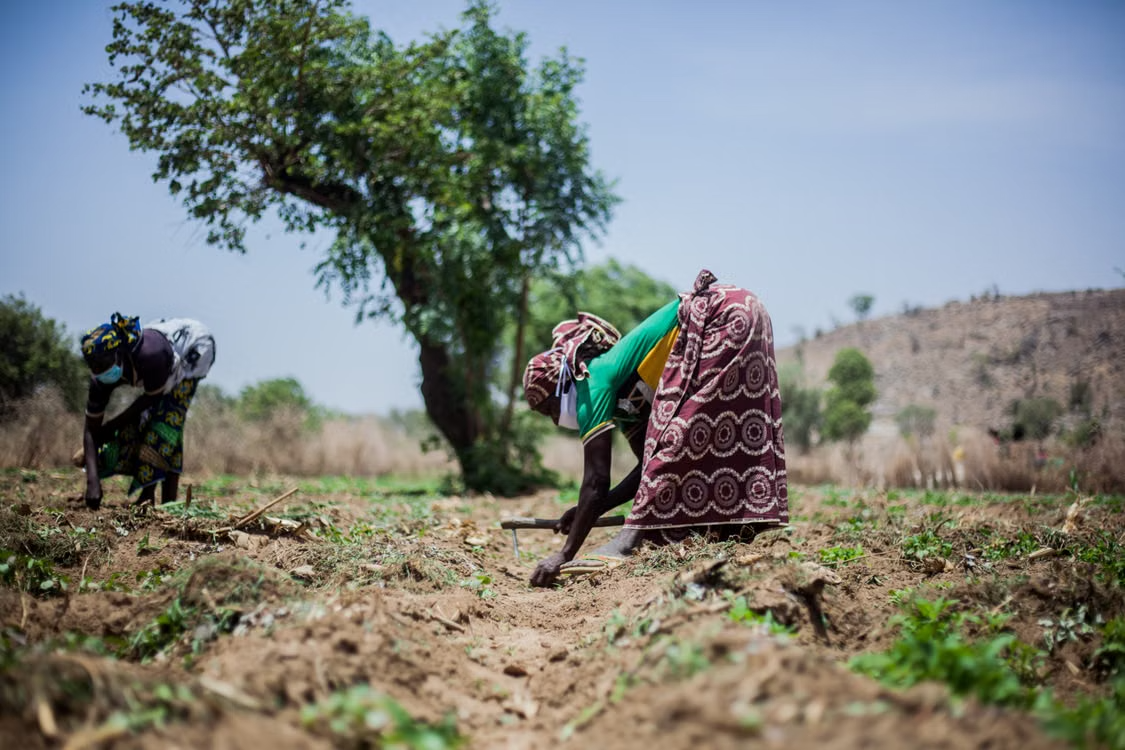
In the Kenya’s drought-prone regions, women farmers are challenging generations of dependence on seasonal rainfall. Armed with climate-resilient seeds, water conservation techniques and collective action, they are demonstrating how communities can produce food despite an increasingly unpredictable climate. Their experiences also expose the barriers preventing millions of smallholder farmers from doing the same.
For decades, the arrival of seasonal rains determined whether farming families in Kenya’s semi-arid regions would harvest enough food, earn an income or face another season of uncertainty. Farmers prepared their land, planted their seeds and waited. When the rains failed, crops withered, household incomes declined and food insecurity followed.
In Makueni County, that familiar agricultural cycle is gradually changing. Women farmers are adopting practices that challenge the assumption that successful agriculture must depend entirely on reliable rainfall. From harvesting runoff water and conserving soil moisture to growing drought-tolerant crops, they are demonstrating that adaptation is not simply about surviving climate change. It is about fundamentally rethinking how food is produced.

For these farmers, the question is no longer when the rains will come, but how much food they can produce with the water available.
At 73, Alice Mueni Mutisya, a farmer from Kyanziu village in Makueni County, has experienced decades of changing agricultural conditions. Unpredictable rainfall, limited resources and rising production challenges have increasingly complicated the farming practices she has relied upon since the 1980s.
Her circumstances began changing after she joined the Kyanziu Farmer Field School, where farmers receive practical training in climate-smart agriculture. Alice learned to use zai pits, small planting basins that collect rainwater and concentrate soil nutrients around crops. She also adopted intercropping, crop rotation, improved spacing and better pest management.
Read also:Africa’s revolutionary voyage towards a sustainable blue economy
According to an April 2026 account published by Mifuko Trust, her maize harvest increased from eight bags to 20 bags in one season. The additional production enabled her to consider investments beyond immediate household consumption, including home improvements and purchasing a water tank.
Her experience illustrates how relatively accessible farming practices can improve productivity. It also demonstrates the importance of agricultural knowledge in helping farmers respond to changing environmental conditions.
From vulnerable seeds to resilient harvests
Elsewhere in Makueni and neighbouring Machakos County, women are changing the crops they grow.
Phoebe Mwangangi, a farmer from Makindu, is among those adopting Nyota beans, a drought-tolerant variety promoted through the Pan African Bean Research Alliance and the Alliance of Bioversity International and CIAT.
Unlike conventional approaches that leave farmers heavily exposed to unpredictable rainfall, the variety is intended to perform better under moisture stress. Its nutritional qualities, including zinc content, and shorter cooking time provide further benefits for households.
Phoebe’s farming approach also incorporates water management and conservation agriculture, allowing her to reduce dependence on rainfall alone. Her experience reflects an important shift in agricultural adaptation: resilience increasingly depends on combining improved seeds with better soil management, water conservation and access to agricultural information.
The transformation extends beyond individual farms. Women are sharing knowledge, encouraging others to experiment with new practices and gradually influencing agricultural decisions within their communities.
Harnessing the power of collective action
For many women, access to climate-resilient technologies remains constrained by limited financial resources, insecure land ownership and inadequate extension services. Collective action is helping address some of these barriers.
In Makindu, the Kimatwa Women’s Savings and Credit Cooperative has become an important platform for promoting climate-smart agriculture, financial literacy and farmer learning. Working with researchers through the Accelerating Impacts of CGIAR Climate Research for Africa initiative, the cooperative has supported efforts to strengthen agricultural adaptation and women’s participation in decision-making.

A 2025 initiative involving 120 farmers examined barriers to adopting climate-smart practices, including challenges associated with financing, markets, household responsibilities and institutional support.
The significance of such initiatives extends beyond improved harvests. When women can access agricultural knowledge, financing and collective markets, they gain greater opportunities to influence how resources are invested and how agricultural income is managed.
Why adaptation does not guarantee food security
Despite these encouraging experiences, evidence suggests that climate-smart agriculture does not benefit all farmers equally. A study published in Frontiers in Sustainable Food Systems in January 2025 surveyed 521 households in Makueni County and found that 72% had experienced reduced rainfall to a large extent, while 75% reported recurrent and prolonged droughts.
Conservation agriculture was practised by 69% of surveyed households, while 47% adopted drought-tolerant crops. Yet the findings revealed an important inequality. Although certain adaptation strategies were associated with improved food security among male-headed households, the same benefits were not consistently observed among female-headed households
From same author: Africa’s revolutionary voyage towards a sustainable blue economy
The study highlights a fundamental challenge: providing women with better agricultural technologies does not automatically address the structural inequalities that undermine their food security. Land ownership, access to credit, household decision-making and income opportunities all influence whether adaptation produces meaningful and lasting improvements.
For a woman farming a small piece of land without affordable financing or reliable markets, even a successful harvest may provide limited economic security.
How they are rewriting the future of food security
Kenya’s experience offers important lessons for agricultural policy across Africa. Climate adaptation cannot be reduced to distributing improved seeds or installing irrigation equipment. It requires sustained investment in agricultural extension, water infrastructure, affordable financing, market access and women’s economic participation.
It also requires recognising farmers as innovators whose practical experience can inform agricultural research and public policy. The experiences of women such as Alice and Phoebe demonstrate what becomes possible when scientific knowledge is connected to local farming realities.
Their achievements should not obscure the continuing risks of drought, high input costs and unequal access to resources. Rather, they provide evidence of what targeted support can make possible.
As climate change continues to disrupt conventional agricultural seasons, the future of Kenya’s food security may increasingly depend on farmers who are learning to produce more with less predictable rainfall.
For these women, adaptation is taking shape in ordinary farming decisions: the seeds they plant, the water they conserve, the soil they protect and the knowledge they share. They have not eliminated their dependence on rain. They are learning how to make every drop count.