


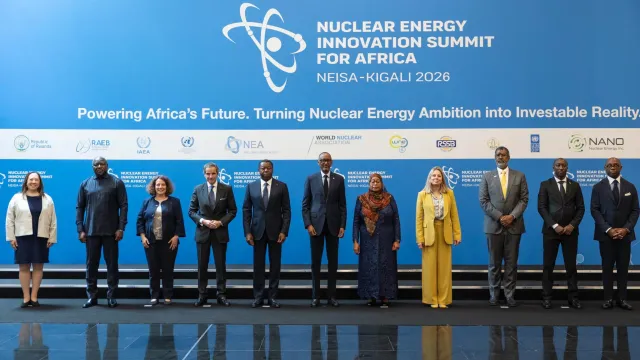
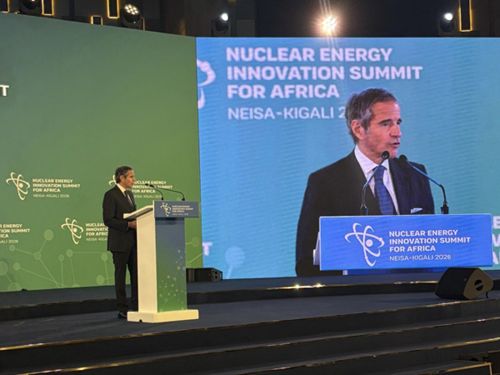
Africa’s push to expand nuclear energy is gaining momentum, but financing remains the continent’s biggest obstacle to turning ambitious plans into operational projects, according to International Atomic Energy Agency (IAEA) Director General Rafael Mariano Grossi.
Speaking at the second edition of the Nuclear Energy Innovation Summit for Africa (NEISA 2026) held in Kigali from May 18 to May 21, Grossi called for a new financing framework capable of accelerating nuclear energy development across the continent.
Grossi argued that nuclear energy should no longer be viewed solely as a technological issue but as a broader development and financing challenge that requires innovative investment structures and stronger international support.
His remarks come at a time when African countries are facing rapidly rising electricity demand driven by industrialization, urbanization, population growth and digital transformation. Across the continent, governments are under growing pressure to secure reliable, low-carbon and large-scale energy sources capable of supporting long-term economic growth.
According to Grossi,
Africa is approaching a critical turning point where nuclear energy is shifting from a distant policy ambition to a more realistic component of national energy strategies.
More than 20 African countries have already announced plans to integrate nuclear power into their future energy mixes as part of broader efforts to diversify electricity generation, reduce dependence on fossil fuels and strengthen energy security. However, despite these announcements, implementation remains slow and uneven due largely to the extremely high upfront costs associated with nuclear infrastructure.
For many African economies already grappling with debt constraints, financing large-scale nuclear projects remains one of the most difficult barriers to overcome. Nuclear plants require billions of dollars in long-term investment, sophisticated infrastructure, highly specialized technical expertise and stable regulatory systems capable of supporting decades-long project lifecycles.
Grossi’s call for new financing mechanisms comes amid significant changes in the international development finance landscape. In June 2025, the World Bank officially lifted its long-standing ban on financing nuclear energy projects, ending a restriction that had been in place since 2013.
World Bank President Ajay Banga said the institution’s return to nuclear financing reflected the growing urgency of meeting electricity demand in developing economies while supporting cleaner energy transitions.
According to World Bank estimates, electricity demand across developing countries is expected to more than double by 2035. To meet that demand, annual investment in power generation, electricity grids and energy storage infrastructure would need to rise from approximately $280 billion currently to nearly $630 billion annually.
The policy shift is being viewed by many energy analysts as a potentially transformative development for African nuclear ambitions. Access to multilateral financing could help reduce investment risks, attract private capital and improve the bankability of future nuclear projects across the continent.
At present, South Africa remains Africa’s only operational nuclear power producer through the Koeberg Nuclear Power Station near Cape Town. The country has relied on nuclear energy for decades as part of its electricity mix, though ongoing energy shortages and load-shedding crises have renewed debate about expanding generation capacity.
Meanwhile, Egypt is currently constructing four nuclear reactors at the El Dabaa Nuclear Power Plant, making it the continent’s most advanced new nuclear project. The development, estimated to cost around $30 billion, is being financed largely through Russian support, with approximately 85% of funding provided via a Russian state loan.
Egypt’s El Dabaa project is widely regarded as a test case for whether large-scale nuclear infrastructure can be successfully delivered in Africa under emerging financing partnerships involving international state-backed investment.
Despite growing interest, most African nuclear programs remain at the planning or feasibility stage. Countries including Kenya, Ghana, Nigeria and Rwanda have all explored nuclear energy options as part of long-term electricity diversification strategies, though few have secured financing or begun construction.
Energy experts say nuclear power could offer Africa several strategic advantages if financing challenges are resolved. Unlike intermittent renewable energy sources such as solar and wind, nuclear power provides stable baseload electricity capable of supporting industrial activity, large urban centers and energy-intensive sectors.
At the same time, proponents argue that nuclear energy could help African countries balance economic growth with climate commitments by providing low-carbon electricity generation as global pressure mounts to reduce greenhouse gas emissions.
However, critics continue to raise concerns about project costs, debt risks, safety standards, radioactive waste management and governance capacity in countries with limited nuclear regulatory experience.
https://www.aecweek-registration.com/2026/?repid=
The financing model advocated by the IAEA aims to bridge the widening gap between Africa’s growing nuclear ambitions and the reality of slow implementation. Analysts say achieving this will likely require blended finance structures, public-private partnerships, multilateral development support and stronger regional cooperation.
As Africa’s energy demand continues to surge, the debate around nuclear power is increasingly shifting from whether the continent needs nuclear energy to whether governments and international institutions can create the financial conditions necessary to make it viable.


