

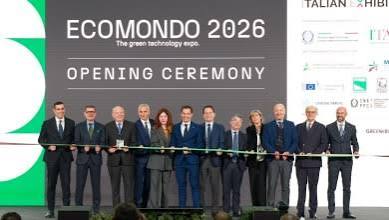
Italy’s green economy is showing uneven progress, with rising greenhouse gas emissions, slow renewable energy deployment, high water consumption and continued dependence on imported energy exposing gaps in the country’s transition towards a more sustainable economy. These findings were presented on 3 November 2026 in Rimini, where the Foundation for Sustainable Development launched its Report on the State of the Green Economy 2026 at the opening of the States General of the Green Economy, held alongside the Ecomondo exhibition.
The report provides an assessment of Italy’s performance across climate action, energy, resource efficiency, water management, transport, agriculture and urban development. While the country maintains a strong position in areas such as recycling and resource productivity, progress in other sectors remains insufficient to meet its 2030 climate and energy objectives. The findings point to a transition in which established strengths in the circular economy coexist with structural weaknesses in energy security, infrastructure investment and climate resilience.
Presenting the report, Edo Ronchi, President of the Foundation for Sustainable Development, described the overall position of Italy’s green economy as critical, despite some positive developments. He also pointed to growing public and business interest in the ecological transition, citing an IPSOS survey that indicated an increase in green awareness among citizens and companies.

The assessment comes against a wider international backdrop in which the economic case for the green transition is increasingly linked to resilience and competitiveness. Ronchi referenced the 2025 annual report of the Partnership for Action on Green Economy, produced through collaboration among five United Nations agencies, which identifies ecological transition as a structural necessity for countries facing constrained public finances, economic uncertainty and growing climate threats. The report argues that environmental transformation can also support economic growth and social inclusion.
For Italy, however, the scale of the climate challenge is becoming more pronounced. The country sits within the Mediterranean climate hotspot, a region particularly exposed to rising temperatures, droughts, extreme rainfall and other climate-related disruptions. Average temperatures in Italy have increased by more than 2°C over the past 50 years, exceeding the global average increase. During the summer of 2026, prolonged extreme heat affected cities across the country, creating health risks for vulnerable populations and, according to the report, conditions capable of threatening even otherwise healthy individuals. More than 2,300 extreme weather events were recorded in 2025.
The pressure is also reflected in Italy’s emissions trajectory. After several years of decline, greenhouse gas emissions increased in 2025, although the report indicates a slight decrease in 2026. Between 2015 and 2024, Italy reduced emissions by an average of approximately seven million tonnes annually. However, meeting the country’s 2030 objectives under its National Integrated Energy and Climate Plan (PNIEC) will require annual reductions of around 14 million tonnes from 2026. This would mean doubling the pace achieved over the preceding years.
The gap raises questions about the pace of implementation across energy, transport, buildings and industrial production. Without faster reductions, Italy risks falling short of its climate commitments, particularly as the effects of extreme weather increasingly affect infrastructure, agricultural output and public health.
Renewable energy deployment presents another major challenge. Italy’s PNIEC sets a target for renewables to account for 39.4% of total energy consumption by 2030, covering electricity, heating, cooling and transport. Yet renewables represented only 19.6% of total consumption in 2024, below the European Union average of 25.2%.
The shortfall is particularly evident in heating and transport. Renewable sources accounted for approximately 20% of energy consumed in heating and cooling in 2024, compared with a 2030 national target of 35.9%. In transport, the renewable share stood at 10%, substantially below the 34.2% target. Electricity generation also remains behind the intended trajectory: renewables supplied 47% of Italy’s electricity in 2025, while the PNIEC envisages a 70% share by 2030.
Installation rates underline the challenge. Italy added 7.2 gigawatts of renewable energy capacity in 2025, compared with 23.3 GW in Germany and 10.8 GW in Spain. To remain on course for its national targets, Italy will need to increase annual renewable installations to approximately 10 GW. The difference between current deployment and the required pace points to the importance of permitting processes, grid capacity, investment conditions and the ability to connect new generation projects to consumers.
Energy security remains closely connected to this transition. Italy’s dependence on imported energy has averaged approximately 74% in recent years, substantially above the EU average of around 57%. This exposure leaves the economy vulnerable to external supply disruptions and fluctuations in international energy prices.
There are, nevertheless, signs of relative efficiency. Italy’s energy intensity stood at 72 tonnes of oil equivalent per million euros of gross domestic product in 2024, better than the EU average of 85. However, energy consumption per unit of GDP has fallen by 30% over the past two decades, compared with a 36% reduction across the EU. Germany recorded a 42% decline over the same period, while France and Spain each achieved reductions of 36%. The figures suggest that Italy has an established efficiency advantage but has made slower progress in reducing the energy required to generate economic output.
The report identifies the circular economy as one of Italy’s strongest areas of performance, although this has not eliminated its reliance on imported materials. In 2025, material import dependence stood at 47.1%, more than double the EU average of 22.1% and above Germany’s 39.7%. This exposes the country to external supply risks even as it performs comparatively well in recovering and reusing resources.
Italy recorded resource productivity of €4.6 of GDP per kilogram of material consumed in 2025, compared with the EU average of €3, Germany’s €3.9 and €3.8 in both France and Spain. Its circular material use rate reached 21.6% in 2024, against 12.2% across the EU. The country also recycled 86% of waste in 2022, compared with 44% in Germany and 52% in France, while recycling 77.3% of packaging waste in 2025.
These results demonstrate the contribution of recycling systems and resource efficiency to reducing pressure on primary materials. However, the high level of material import dependence suggests that circularity has not yet translated into sufficient domestic resource security. Strengthening reuse, repair, recycling and secondary-material markets could help reduce exposure to imported inputs while supporting industrial competitiveness.
Water management represents a more serious structural vulnerability. Italy is identified as the European country with the highest water consumption for civil and industrial uses and ranks second, after Spain, in withdrawals for agricultural purposes. Annual water availability per inhabitant is approximately 2,260 cubic metres, less than half the EU average. Climate change has contributed to a 20% reduction in water availability compared with the beginning of the twentieth century, according to the Italian Institute for Environmental Protection and Research (ISPRA).
The effects are already visible in the country’s water infrastructure and agricultural regions. During the summer of 2024, drought affected approximately 40% of Italy’s territory. At the same time, more than 40% of water introduced into the national distribution network is lost through leakage. The reuse of purified wastewater remains limited, at approximately 4%, despite estimates from the Italian National Agency for New Technologies, Energy and Sustainable Economic Development (ENEA) that the potential for national water recovery could reach 23%.
The figures highlight a combination of resource pressure and infrastructure inefficiency. Improving water security will require investment in distribution networks, wastewater treatment and reuse, alongside more efficient irrigation and demand management. With agricultural production increasingly exposed to changing rainfall patterns and prolonged drought, water recovery could become an important part of Italy’s climate adaptation and food security strategies.
Transport is another sector experiencing a gradual shift, although the pace of change remains uneven. The national vehicle fleet improved in 2025 as the number of diesel and petrol vehicles declined while hybrid and electric vehicles increased. During the first half of 2026, hybrid vehicles accounted for 49.7% of car sales, up from 44.4% in the corresponding period of 2025. Plug-in hybrid vehicles increased from 5.3% to 9%, while battery-electric vehicles rose from 5.2% to 8.4%. Together, the latter two categories accounted for 17.4% of sales.
Petrol vehicle sales declined from 26% to 19.7%, while diesel fell from 10% to 6.8%. The changing sales mix indicates growing consumer acceptance of lower-emission vehicles, but the report points to a broader transport investment gap. Between 2015 and 2025, the National Transport Fund, which finances local and regional public transport, increased by only 6% in nominal terms. Adjusted for inflation, its value fell by 13.5% in 2025 compared with 2015, leaving it approximately €660 million below its earlier level.
This funding trajectory raises concerns about the ability of public transport systems to provide an accessible alternative to private vehicles. Expanding electric vehicle adoption alone will not address congestion, transport emissions or unequal access to mobility if investment in buses, rail and local transport infrastructure remains inadequate.
Agriculture also faces mounting climate and market pressures. In 2025, the sector recorded an increase in added value, largely driven by higher prices, while production volumes remained almost unchanged. Climate-related losses have become a growing concern, with the European Environment Agency attributing 54% of agricultural production losses to drought and 21% to very intense rainfall.
The report also records a reversal in organic farming for the first time in a decade. Certified and converting organic agricultural areas declined by 5.4% in 2025 compared with 2024, following growth of 59.3% between 2015 and 2024. Sicily and Puglia continue to have the highest concentrations of organic agricultural land. Meanwhile, the value of Italy’s protected designation of origin (PDO) and protected geographical indication (PGI) production increased to €20.7 billion, demonstrating the continued economic importance of recognised regional food products.
The contrasting trends suggest that agricultural competitiveness is being shaped by both environmental conditions and the value attached to product origin and quality. While PDO and PGI markets offer opportunities for higher-value production, declining organic areas and climate-related crop losses point to the need for stronger adaptation measures, improved water management and investment in resilient agricultural systems.

At the urban level, the report identifies growing interest in ecological transition initiatives, with several Italian cities implementing climate adaptation measures through the National Recovery and Resilience Plan (PNRR). Climate shelters are becoming more widespread, often alongside interventions designed to reduce urban heat islands. The report also highlights the development of sponge-city approaches, which use permeable and green surfaces, retention areas, ponds and wetlands to absorb and manage intense rainfall.
Such infrastructure can reduce flood risks while allowing rainwater to be stored for reuse during periods of scarcity. Green urban spaces and water-retention systems can also help lower temperatures in densely built areas. Their growing adoption points to the role of cities as important centres of climate adaptation, particularly as heatwaves and intense rainfall place additional pressure on public infrastructure and urban populations.
The findings from the 2026 report present a mixed picture of Italy’s green economy. Strong performance in resource productivity, recycling and the growth of lower-emission vehicle sales provides a foundation for further progress. Yet the increase in emissions, slow renewable energy deployment, dependence on imported energy and materials, water losses and inadequate public transport investment expose gaps between national ambitions and implementation.
The broader challenge is not simply to establish environmental targets but to accelerate the investment and institutional changes needed to achieve them. Italy’s experience illustrates how progress in one area of the green economy can coexist with persistent weaknesses in another. As climate risks intensify across the Mediterranean, the ability to connect energy transition, industrial efficiency, water security, agricultural resilience and urban adaptation will increasingly determine the country’s economic and social resilience.