A quiet soil health crisis is unfolding beneath Kenyan farms, from Bungoma to Uasin Gishu, with consequences for food security, fertiliser efficiency and sustainable land use. Despite public investment through Kenya’s fertiliser subsidy, yields remain below potential in many breadbasket areas. Farmers apply DAP, plant improved seed and wait for the rains, only to watch crops turn pale and weak. The fertiliser is in the ground, but the harvest still disappoints.
The problem is not only fertiliser access. It is soil chemistry. Research confirms that soil acidity is a serious constraint in major food-producing areas, particularly in western, central and Rift Valley Kenya. Estimates of the affected area vary by pH threshold and land classification, but the evidence consistently identifies acidity as a major threat to soil fertility, crop response and food security. A market assessment describes the problem as especially acute in Kenya’s maize-growing breadbasket.
Nutrients become less available in strongly acidic soils, especially below pH 5.5. Phosphorus is readily fixed by aluminium and iron compounds, while aluminium and manganese toxicity can restrict root growth. This helps explain why farmers may apply fertiliser correctly but still see poor results. The Soil Acidity and Liming Handbook for Kenya identifies soil testing and liming as central responses, while studies from western Kenya show how acidity, phosphorus fixation and exchangeable aluminium interact.

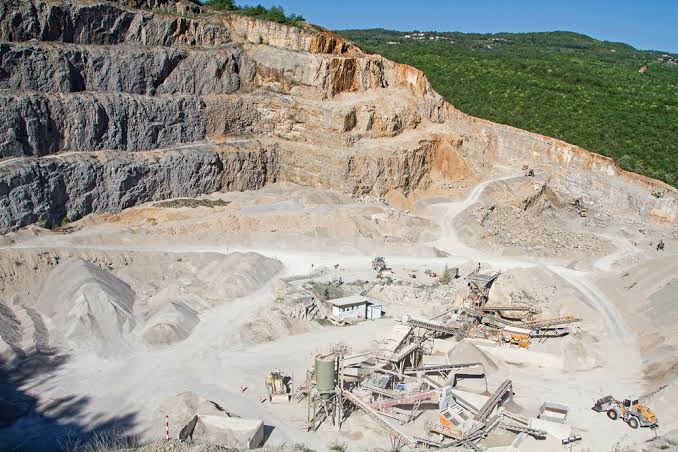
The solution is not simply more fertiliser. It is soil restoration, starting with agricultural lime. Lime raises soil pH, reduces exchangeable aluminium and improves nutrient availability. It can support microbial activity and biological nitrogen fixation in legumes. Field research in western Kenya found that combining lime with fertiliser improved soil chemical conditions and crop performance. Kenya also has domestic limestone resources in Kitui, Kajiado, western Kenya and the coastal belt, linking local mineral production to agricultural recovery. Properly managed, this creates a practical circular-economy opportunity. Mineral resources can be processed into inputs that restore degraded soils and improve fertiliser efficiency.
The technical choice matters. Calcitic lime, mainly calcium carbonate, is useful where soils are acidic and calcium is required. Dolomitic lime, containing calcium and magnesium carbonate, is better suited where magnesium is deficient. Agricultural lime is also compatible with organic farming systems when used according to certification rules because it is a naturally occurring mineral amendment, although calcium carbonate is technically an inorganic mineral rather than an organic carbon-based material. Gypsum does not neutralise soil acidity in the same way as lime, but it can supply calcium and sulphur and improve particular soil constraints. The rule should be simple: test the soil first, then match the amendment and rate to the diagnosed deficiency.
Kenya must move beyond the old image of lime as dusty quarry powder. Liming has long been perceived as messy, heavy and difficult for smallholders to apply. Pelletised lime aggregates finely ground limestone into larger particles, reducing dust and making spreading easier. Granulated products marketed locally, including SeedPro’s CalcPro, Chiromo Fertilizer’s CalciGrow and other agricultural lime formulations seek to make pH correction easier to handle, transport and apply. As with all soil amendments, farmers and distributors should rely on verified neutralising value, fineness and application rates.
Private innovation cannot scale this transition alone. Kenya’s National Fertilizer Subsidy Program was introduced in 2022 to boost food production and stabilise input prices, but a sustainable food-systems approach requires the design to evolve beyond cheaper fertiliser toward stronger soil-health outcomes. Kenya’s Agricultural Sector Transformation and Growth Strategy has proposed soil-based recommendations and compulsory lime vouchers for farmers with acidic soils, while the Ministry of Agriculture and Livestock Development’s Strategic Plan records the shift toward e-vouchers.
Lime should therefore be treated as a strategic input, not an optional extra. Kenya has experience with flexible e-vouchers targeting different farmers and inputs. A stronger soil-health approach should make liming part of fertiliser support in acidic zones, backed by soil testing, extension advice and local distribution networks. The National Agricultural Sector Investment Plan also points toward more targeted agricultural support.

The logistics are as important as the chemistry. Moving heavy lime over long distances can sharply increase farm-gate prices. Local grinding, blending and distribution hubs would reduce transport costs, create rural enterprise opportunities lower unnecessary logistics burdens and bring this corrective mineral closer to farmers. The African Union’s Action Plan calls for stronger soil-health systems, greater fertiliser-use efficiency, local production and better access to appropriate inputs. The Nairobi Declaration places soil restoration at the centre of Africa’s agricultural transformation.
Kenya requires a “no diagnosis, no prescription” rule. Farmers should not keep buying fertiliser without knowing whether their soils can use it. Soil testing, digital advisory tools and soil-health cards can help farmers stop farming in the dark and make better decisions about lime, fertiliser and organic matter. Kenya is expanding digital agriculture through platforms linked to KALRO, while the World Bank’s soil challenge and FAO’s SoilFER programme show how soil data and digital mapping can guide more precise recommendations.
Food security is not only about seed and rain. It is also about the chemistry below the ground. If Kenya intends to raise farm productivity and reduce pressure from imported staples and food commodities, it must stop fertilising the problem and start liming its future. The wider lesson for Africa is clear. Sustainable agriculture begins with knowing, restoring and managing the soil beneath the crop.