


A European Union-backed agricultural programme in Zambia’s Eastern Province is accelerating the transition from subsistence farming toward climate-resilient agribusiness systems, as more than 54,000 smallholder farmers adopt sustainable farming practices aimed at improving productivity, strengthening food security and increasing rural incomes under worsening climate pressures.
The Sustainable Intensification of Smallholder Farming Systems (SIFAZ) project, implemented by the Food and Agriculture Organization of the United Nations in partnership with Zambia’s Ministry of Agriculture and the International Maize and Wheat Improvement Center (CIMMYT), has emerged as one of the country’s largest integrated agricultural resilience initiatives. Supported through more than EUR 32 million in European Union financing, the programme combines agricultural research, mechanization support, farmer training and private sector engagement across 27 districts in Zambia.
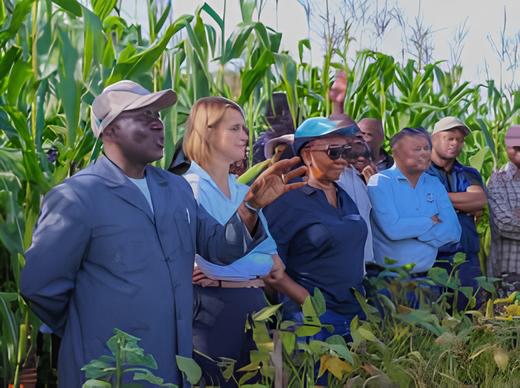
According to programme data, over 18,000 hectares are now under Sustainable Intensification Practices, while farmer cooperatives have mobilized more than ZMW 78 million in agribusiness investments linked to mechanization services, input access and market integration. The project has also facilitated partnerships with 20 private sector companies and strengthened 143 cooperatives to improve commercial participation and supply chain coordination.
The programme’s expansion comes as Zambia and several African economies face mounting pressure to increase agricultural productivity amid rising climate variability, declining soil fertility and growing fiscal constraints. Across sub-Saharan Africa, smallholder farmers account for most food production yet remain highly exposed to droughts, erratic rainfall and limited access to financing, infrastructure and agricultural technologies.
According to the African Development Bank, agriculture contributes approximately 20% of Africa’s gross domestic product and supports more than half of the continent’s workforce. However, weak mechanization levels, fragmented value chains, and limited extension services continue to suppress productivity and rural incomes across many countries.
In Zambia’s Eastern Province, where subsistence farming has historically dominated household livelihoods, SIFAZ has focused on integrating scientific research with locally adapted farming systems designed to improve resilience and market participation. Through “mother and baby trials”, farmers test climate-sensitive technologies under real production conditions before wider adoption.
CIMMYT representatives involved in the initiative said the research model prioritizes co-development between farmers and agricultural scientists to ensure technologies are practical, scalable, and responsive to local ecological conditions. Across participating communities, the programme has established 118 mother trials and more than 3,100 baby trials focused on soil restoration, yield improvement and climate adaptation.
Participating farmers report more stable harvests despite increasingly unpredictable rainfall patterns. Chitundu Zulu, a farmer in Chipata District, said, improved agronomic practices introduced through the programme had increased household production and strengthened food security. Other farmers noted that climate-resilient technologies were helping sustain yields during poor rainfall seasons that previously resulted in severe crop losses.
The initiative also reflects a wider shift in African agricultural policy toward market-oriented farming systems capable of integrating smallholders into commercial value chains. Through cooperative strengthening and private sector partnerships, SIFAZ is supporting transitions into seed production, mechanized farming, and structured commodity markets.
Adamson Daka, chairperson of the Chipili Multipurpose Cooperative Society in Chadiza District, said collective purchasing systems and stronger market access had improved incomes and operational efficiency among cooperative members. Mechanization services supported through the programme have also reduced labour burdens, particularly for women farmers who remain heavily involved in manual agricultural production across rural Zambia.
For Zambia’s economy, agricultural productivity improvements carry implications extending beyond rural livelihoods. Agriculture remains a major source of employment; export earnings and food supply stability, while climate-related production shocks continue to affect inflation, import dependency, and fiscal planning.
According to Zambia’s Ministry of Agriculture, lessons from the SIFAZ programme are being integrated into national systems including the Farmer Input Support Programme and the Food Security Pack as authorities seek to strengthen long-term resilience within the agricultural sector.
Agriculture Minister Reuben Mtolo Phiri said the initiative had expanded mechanization access, strengthened agronomic skills and increased participation of women and young people in agricultural value chains. He noted that coordinated investment and institutional collaboration remain central to improving productivity and reducing vulnerability to climate disruptions in rural economies.
The programme is also expanding the use of digital agriculture platforms to improve extension services and knowledge transfer. Thousands of farmers are now accessing technical guidance and climate adaptation information through digital systems designed to extend advisory support into underserved rural communities.
Across Africa, digital agriculture is increasingly viewed as a critical tool for addressing longstanding extension of service gaps. According to the Alliance for a Green Revolution in Africa, digital advisory systems could improve input efficiency, climate adaptation and market access for millions of farmers, although limited connectivity and uneven infrastructure continue to constrain adoption in some rural regions.
European Union Ambassador to Zambia and COMESA Karolina Stasiak described the programme as part of broader efforts to strengthen climate-resilient agricultural systems and private sector participation within rural economies. FAO Representative Suze Percy-Filippini said the initiative demonstrates how coordinated systems linking research, policy, markets and financing can produce measurable gains in resilience and productivity.
For African policymakers and development financiers, the Zambian programme reflects growing interest in integrated agricultural transformation models capable of combining donor support, private investment and public sector coordination. Analysts say such approaches may become increasingly important as governments seek to modernize agriculture while managing rising debt servicing obligations and constrained fiscal space.
The project also illustrates the growing role of blended finance structures in African rural development, particularly where climate adaptation and food security objectives intersect with commercial investment needs. Development institutions are increasingly prioritizing scalable agricultural systems capable of reducing climate vulnerability while improving long-term economic participation for smallholder farmers.
For farmers such as Alick Banda in Chadiza District, participation in seed production and commercial farming activities has altered long-term income prospects. Banda said the programme enabled him to move beyond subsistence production into market-oriented agriculture, increasing household earnings and improving confidence to reinvest in farming operations.
His experience reflects a broader structural transition underway across parts of rural Zambia, where climate-resilient farming systems, cooperative development and agribusiness integration are gradually reshaping agricultural production and local economic activity.


